- Hey Mike
- Posts
- The creator who sold his face for $975 million
The creator who sold his face for $975 million
How Khaby Lame sold his digital likeness.

Mike Epstein
February 05, 2026
Hi,
One of the biggest news stories in the creator space last week was Khaby Lame (the biggest TikTok influencer in the world with 160 million followers), selling his company in a deal that was reportedly valued at $975 million (yes, you read that correctly lol). When I first stumbled across the headline, I thought I was reading the number wrong and couldn’t believe my eyes.
Almost $1 billion is insane. After seeing it pop-up in multiple places, my curiosity got the best of me and led me down a rabbit hole. The story is a fascinating one that might have implications for artists and creators everywhere in the future.
Let’s explore below.
This newsletter highlights:
Khaby Lame selling his digital identity
The Vault
B-Sides
Industry spotlight
10 music industry job opportunities
Let’s dive in ⬇️
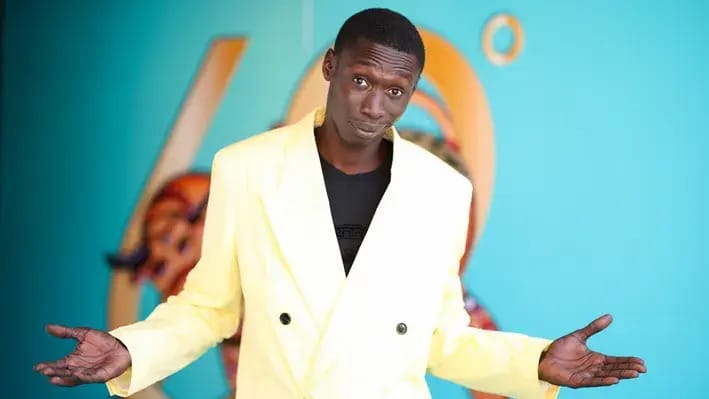
This is Khaby Lame - he went from working in a factory in Italy and getting laid off during COVID to becoming the biggest TikTok creator in the world. With over 160 million followers, he ultimately signed what is being called the largest monetization deal in creator history - all in 6 years.
My first reaction was “holy s**t, that’s a lot of money” (lol) followed shortly thereafter by “wait, what is this deal actually for?”
The deal itself
The first thing I discovered is that there’s some nuance to how the economics of the deal actually work.
Khaby sold his company, Step Distinctive Limited, to another company named Rich Sparkle Holdings based in Hong Kong. It was an all-stock deal, not a cash deal…meaning he didn't technically walk away with $975 million cash.
He essentially got shares in a company. There’s a few layers:
Khaby owned 49% of the company. The other 51% was held by vendors and strategic partners. So his share, on paper, is closer to $477 million - still massive, but half the headline number.
The stock he received has been volatile. Rich Sparkle went public last summer selling shares at $4 each, implying the company was worth about $50 million. After the Khaby deal was announced, shares spiked to $150, briefly giving the company a $1.8 billion market cap. Then it crashed to around $41 - a 75% drop from the peak. Once the stock stabilizes, it’ll be interesting to see how much it’s actually worth.
The deal is fascinating not just because of how expensive it was, but because of what was actually sold. Khaby didn't just sell his ownership in a company - he sold the exclusive commercial rights to his identity for 36 months while authorizing the creation of an AI clone that can operate independently of him.
Yeah…we’re officially in the future lol.
Digital identity
While digging deeper, I learned that the deal grants Rich Sparkle the rights to Khaby's Face ID, Voice ID, and what is referred to as his "signature behavioral cues." They can essentially use these assets to build a hyper-realistic digital version of Khaby that creates content without him actually being present. For example, his digital identity could host multiple live streams across the world at the same time without ever having to actually be in any of them.
I’m assuming the company's pitch was likely that Khaby's AI “twin” can operate around the clock and make him more money. While the real Khaby sleeps, his digital self can be selling products, posting content, and hosting livestreams. His brand essentially has the potential to run 24/7 and never go offline.
Rich Sparkle estimated this could generate $4 billion in annual sales by leveraging Khaby's 360 million total followers and building on top of a business that he already created.
On the surface, I imagine this might sound like the ultimate creator dream. You build the audience, then your digital self does the work while you generate passive income at a scale that never existed before.
But underneath that, there's a really big question:
If your AI clone can do everything you do, then what do you become?
ABBA
While Khaby's deal is the biggest, artists and creators have been navigating digital identity for a few years now.
In 2022, the Swedish pop group created ABBA Voyage - a virtual concert residency in London where digital avatars (called "ABBAtars" lol) perform as the group actually looked in 1979, with a live 10-piece band. A company called Industrial Light & Magic used a team of 850 people to create the digital versions.
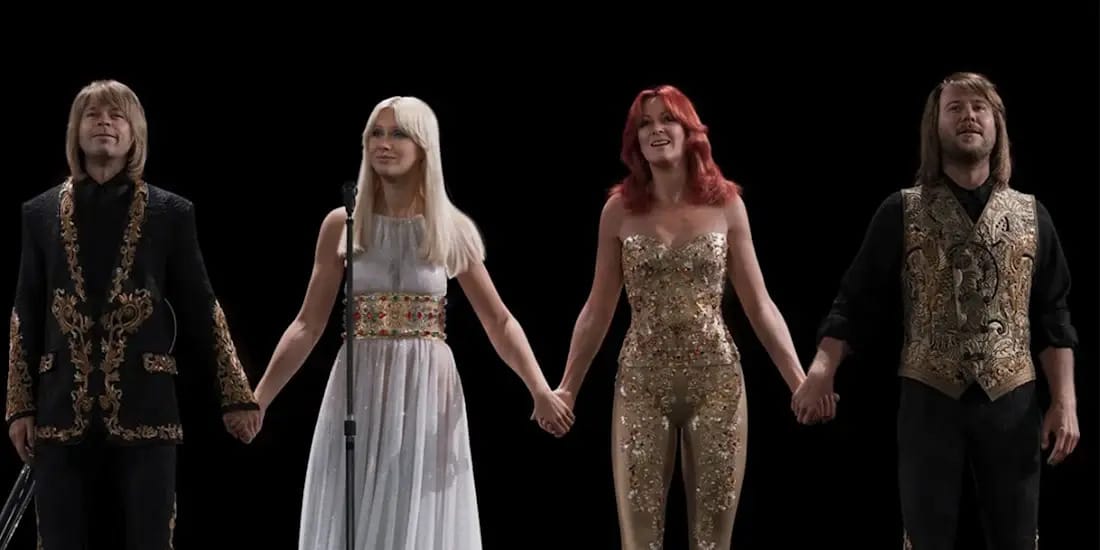
The residency generated $129 million in revenue in 2023 and $113 million in 2024 with over 2 million visitors. Reports claim the show has contributed an estimated $1.4 billion to the UK economy and has been extended through August 2026.
ABBA spent $175 million to produce it (INSANE lol) but the avatars perform 6 nights a week, they never get tired or cancel shows, and they look exactly the same every night. The members of ABBA (who are in their 70s and 80s) don't have to do anything.
They built the digital version once and let it perform forever.
What this looks like for musicians
This is where it gets really interesting and also really complicated.
Virtual concerts. ABBA proved virtual concerts can be massively lucrative and generate over $100 million a year. It creates a not-so-distant reality where an artist can "tour" in ten cities simultaneously through AI avatars. No travel, burnout, or cancelled shows. The economics of touring, which are already brutal for most artists, fundamentally change if a digital version can perform. Obviously it takes a massive investment to create these digital avatars but if the resources are there, the ability to scale unlocks dramatically.
AI features and collaborations. Right now getting a feature from a major artist requires coordinating schedules, studio time, and sometimes significant fees. What if an artist could license their AI voice for collabs? It sounds crazy but in theory it’s possible…hear me out: a producer could pull up an artist's voice model, create the feature through prompting, and then pay a licensing fee to the artist without the artist ever having to do anything, just approve the song.
This is already sort of happening. YouTube launched a program called Dream Track, which lets creators use AI voice models of artists like Charlie Puth, John Legend, and Sia - with label approval.
Posthumous releases and legacy. This might be the most sensitive area. ElevenLabs partnered with the estates of Judy Garland, James Dean, Burt Reynolds, and Laurence Olivier to create AI versions of their voices. James Earl Jones licensed his voice for AI use so Darth Vader and Mufasa can continue in future productions. Liza Minnelli, Art Garfunkel, and others participated in what's being called the first major AI-generated album made with full artist permission.
Content that never stops. For creators specifically, this is the big unlock. Your AI twin can respond to comments, create social content, appear in brand deals, and engage fans around the clock. YouTube is already launching tools for creators to generate Shorts starring their own digital versions.
The idea: you become a creative director overseeing a business instead of a content creator attached to a camera 24/7.
The risks
This sounds all well and good but there are real risks:
Once you sell your likeness, you lose control of context. Khaby's deal gives Rich Sparkle exclusive commercial rights of his digital identity for 36 months. That means for three years, a company he doesn't control decides how his face, voice, and mannerisms are used online. What if they put his AI twin in an ad he finds offensive? What if they use his likeness to promote a product he doesn't believe in? What if the quality of the AI content is terrible and it damages his brand?
Now…there may be stipulations in the deal that he has to approve everything but even so, what happens if there is a disagreement at some point? The contract presumably has guardrails but the fundamental dynamic shifts: someone else is making decisions about his brand.
Fans might not care about the real version. This is more existential. If your AI clone can produce content that's indistinguishable from you, what incentive do fans still have to engage with the real you?
If people can't tell the difference between real and synthetic content, the concept of authenticity, a big part of what makes creators valuable, starts to disappear.
The legal landscape is a mess. There's no comprehensive federal law in the US governing AI likeness rights. Different states have different rules. If you license your likeness to a company operating overseas, which laws apply?
The valuation might be smoke. The Khaby deal specifically should give everyone pause. A company that made $6 million last year from printing services is suddenly worth billions because it acquired a creator’s likeness rights? The stock went from $4 to $150 to $41 in weeks.
Obviously, I hope it doesn’t but if at any point the deal falls apart, it won’t just hurt Khaby. It sets a narrative that creator IP may not be worth what people claimed, which damages every creator trying to negotiate the value of their likeness.
The real question
As I learn more about this, the main thing for me is:
There's a difference between scaling your work and selling yourself.
ABBA Voyage works because the members of ABBA are in their 70s and 80s - they've already had their careers. The avatars are extending a legacy, not replacing a living artist. Nobody is confused about whether they're seeing the real ABBA.
The Khaby model is different. A 25-year-old at the peak of his cultural relevance sold the exclusive commercial rights to his identity to a company he doesn't control, in exchange for volatile stock in a firm with no track record. For 36 months, "Khaby Lame" the brand potentially operates independently of Khaby Lame the person.
Maybe it works out and he becomes a billionaire. Or maybe Rich Sparkle's stock crashes and he's left with a fraction of what was promised. Either way, the precedent is set: your digital self is now an asset class. And companies are going to start approaching every creator with a significant following and ask the same question: What would you sell your clone for?
If a company offered you a significant amount of money for the right to create an AI version of you (your face, your voice, your mannerisms), what would you say?
What would your price be? And more importantly - what would your terms be?
More of these offers are coming…maybe not tomorrow but in the not-so-distant future. Our digital selves are about to become one of the most valuable assets we own.
Hopefully this was helpful on your journey.
Thanks for reading, until next time.
The Vault
1) Emergent - my cousin actually introduced me to this one! It’s similiar to Lovable, a platform that can be used for building web applications with AI but Emergent has more integrations. For example, it recently just integrated with Claude Sonnet 4.5 More info HERE
B-Sides
⚡ SUNO inks massive licensing deal HERE
⚡ YouTube adds AI prompting to year end recap HERE
What I’m listening to…
Industry spotlight
These industry professionals are looking for open roles:
⚡ Derek Spence - Los Angeles, CA: "I’m an audio engineer with extensive experience recording, mixing, and managing sessions at top studios like Record Plant, Harbor Studios, and Craft Studios. I bring a mix of technical expertise, creativity, and client-focused workflow, making sure the artist’s visions come to life. I’m looking for recording and mixing engineer roles.” - LinkedIn
If you’ve been impacted by layoffs and are looking for an open role in the music or entertainment industry, submit for a chance to be featured in the Industry Spotlight section HERE
Music industry job opportunities
1) Digital Rights & Content Operations Coordinator – Rebel Creator Services
Salary: $30,000 - $40,000
Location: Remote
Apply HERE
2) Social Media Strategy and Digital Advertising Coordinator/Manager - Mascot Records
Salary: $40,000 - $60,000
Location: New York, NY
Apply HERE
3) Administrative Assistant/Junior Agent - Dynamic Talent International
Salary: $42,000
Location: Nashville, TN
Apply HERE
4) Music Project Manager / Label Liaison - HYBE America
Salary: $175,000 to $225,000
Location: Santa Monica, CA
Apply HERE
5) Social Media Editor - Music - Future
Salary: £29,000 - £35,000
Location: London, UK / Bath, UK
Apply HERE
6) Marketing Coordinator - MiEntertainment Group
Salary: $40,000–$50,000
Location: Michigan
Apply HERE
7) Director of Music - Aspect
Salary: $150,000 - $200,000
Location: Los Angeles, CA
Apply HERE
8) Brand Manager - Audiio
Salary: Unlisted
Location: Nashville, TN
Apply HERE
9) A&R Coordinator - Warner Music Group
Salary: Unlisted
Location: Nashville, TN
Apply HERE
10) Senior Financial Analyst, Film Production & Music - NBCUniversal
Salary: $80,000 - $92,000
Location: Universal City, CA
Apply HERE
What'd you think of this week's newsletter?Your feedback goes a long way. |
Reply