
Hi,
This week’s newsletter is a follow-up to one I published a few weeks ago, talking about the importance of defining your goals.
I realized that as part of defining things, it’s also important to know the game you’re playing, especially in music. I’ll explain exactly what that means with examples.
Let's get into it below.
This newsletter highlights:
Know the game you’re playing
The Vault
Let’s dive in ⬇️
The music (and entertainment industry) is fascinating in that there are many different paths to success, especially in the modern landscape in 2026. Each path has its own strategy, blueprint, and dynamics that increase the likelihood of success.
Music is akin to sports in that way - each sport has its own set of strategies and way of playing.
For example, let’s look at basketball. While everyone has the same goal (to win the game, playoff series, and championship), each team and player utilizes its own set of strategies to achieve that. Different coaches have different blueprints for how their team plays.
Phil Jackson became famous for his Triangle Offense approach where 3 players form a literal triangle on the court with the other 2 players on the side. The point is the spacing…it allowed extraordinary talent like Kobe Bryant (Rest in Peace) and Shaquille O’Neal to amplify the Lakers’ offense by changing the way the other 3 players on the court participated and interacted in the game. The triangle offense allowed for those 3 players to be active participants, contribute, and be just as dangerous on the court as Shaq & Kobe as opposed to just standing around watching.
Then there was Mike D’Antoni’s 7 Seconds or Less that focused on the offense getting up a shot within 7 seconds or less of having the ball.
Same goal: score the ball but two different strategies.
Both were shaped around what each team had to work with - its players and their respective skillsets.
Part of why Mike D’Antoni’s system worked so well was because of Steve Nash - his ability to make a quick split-second decision off the pick and roll made him one of the more unguardable players at that time and the perfect person to lead that strategy of offense. Nash would go on to win 2 back-to-back MVPs playing in that system - his combination of skill, basketball IQ, and talent made him nearly unstoppable.

Music is similiar in that every successful artist has their own strategy and blueprint. While some people may not like this newsletter or way of thinking (they might think it feels too strategic and calculated and takes away from the art), the truth is that successful artists find and maintain success for a reason. It’s not an accident.
If you look closely, you can identify patterns within those strategies. Look at the way 100 successful artists are releasing music and you will find similarities that maybe didn’t initially appear on the surface.
And truthfully, it’s helpful and important for artists and creators to know…
Here’s an example…
I’m starting to get into playing Padel (I know, I know…like everyone else lol) and really enjoy the game. I want to become somewhat good at it and find myself wondering + wanting to learn everything there is to know about it. I want to learn the variables and develop pattern recognition so that I can develop my own strategy for my individual skillset.
For example, a few things I’m wondering are:
What is the biggest leverage point for players of my size?
What is the biggest weakness for players of my size?
How does the size of my opponent change the strategy, if at all?
How does the size of my teammate change the strategy, if at all?
Where do I need to serve the ball to increase the likelihood of the other team messing up?
I am recognizing that there are different strategies to playing the same game and want to learn one that best suits my skills and how I enjoy playing.
I think it’s helpul for artists + creators to think the same way.
The entire industry (artists, creators, etc) are at the mercy of streaming algorithms and social platform algorithms.
I tweeted this a few days ago:
I find it fascinating to learn the different ways of playing the game and what strategy is best suited for each person.
The first question is which game you're playing
The crazy thing about the music industry is that while it in and of itself is a game, there are a bunch of minigames inside it…with their own rules that reward completely different behavior.
For example, the streaming game runs on volume: consistency, cadence, features, retention, etc. You are feeding a machine that sadly and unfortunately is likely to forget releases after 2 weeks.
The direct-to-fan game runs a little differently. It’s more about scarcity, ownership, repeat purchasing, etc. It’s less about gaming the algorithm and more about shaping buyer behavior.
The catalog and sync game is less about any of that: it cares whether your instrumental exists and your splits are papered lol.
And there are more, those are just a few.
No wonder music careers are so overwhelming and confusing lol. Sheesh!
Here's the important thing though…even if you never identify your own strategy, you don’t just skip the concept. Doing so means you basically just inherit whichever answer is most convenient.
For most artists, it’s streaming because that's what every distributor, playlist company, and marketing blog is selling you. You end up falling into a mini game without even really knowing the rules or that you’re playing one.
Examples
Let’s look at 2 different independent artists playing 2 very different games. They are almost so starkly different that some may think they are false equivalents but I think they’re interesting examples.
Nic D
Nic D is an independent artist living in Culpepper, VA with no label or manager. His catalog has done over a billion streams with +100 singles in it. He does everything on his own and has no interest in being “on the scene”.
His release schedule is aggressive - he has released almost every 2 weeks for years on end and many of his releases are co-primary with other artists. He and Connor Price have been dropping co-primary tracks for most of this year for example. Both are tagged as primary, which means every one of those songs lands on both artist profiles and in both artists' Release Radars. He’s borrowing some of Connor’s audience with every one of those releases while keeping his algorithms warm.

In June, they formalized as a duo called Paperboys and released a 13-track album that collects the 2026 singles they'd already put out. It debuted at #7 on Spotify's Top Debut Albums USA chart.
Nic is a great example of someone playing the streaming game.
Relentlessly releasing music, collaborating with other artists often, and being intentional about his strategy.
Now…this strategy dictates how he approaches everything in his career. An artist choosing to play the streaming game needs to work backwards and understand how that decision affects every aspect of their career.
For example, if they’re going to drop every 2 weeks, that decision affects how they create music at scale. It affects how they think about recording, mixing, mastering, cover artwork, content, etc to be able to release music at that pace. Which songs get content, how many pieces, etc. Their entire business becomes predicated on that strategy. Nic D knows the game he’s playing and plays it well.
The streaming game rewards:
consistency
collab singles (with other people as primary)
collab projects (with other people as primary)
Choosing to release that much changes the dynamic of everything else.
Nems
Nems is an independent rapper from Coney Island, NYC who we went viral a few years ago for his phrase "Bing Bong" (if you’re from NYC, you couldn’t escape it). Before that though, he built a lucrative direct-to-consumer business selling hoodies and hats out of his truck.
He literally pulled up on people who bought his products and handed them their merch out of the truck himself.
Here’s a look at the truck:
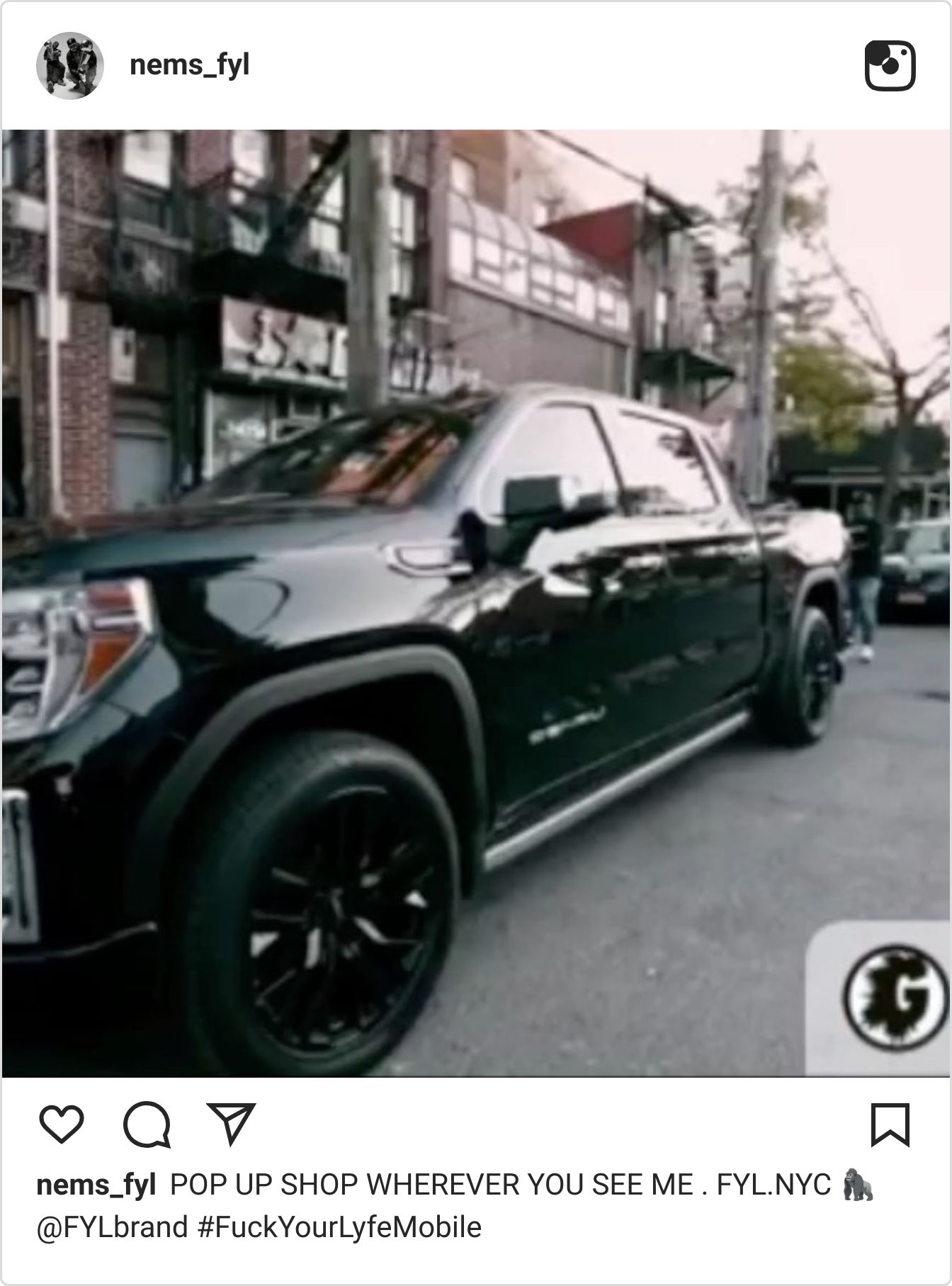
That direct-to-consumer business eventually flourished enough for Nems to open a flagship brick-and-mortar in Coney Island.

When you think about that, it’s kind of insane. Like…super fucking impressive. Building enough demand to open your own brick-and-mortar location and keep the lights on is super difficult. Nems really did it from the ground up and started out of his truck.
It’s funny in a way…the music industry woke up in 2026 with lots of conversations around direct-to-fan marketing and streaming not paying enough anymore. Nems literally ran the whole playbook on this and started before everyone else. He built a community of people and focused his business as an artist on selling those products.
Side by side
It’s interesting to look at both side by side:
Nic D focuses on gaming streaming consistency + algorithms
Nems focuses on selling products and building community
Same discipline.
Two completely different games.
What’s interesting is that by Nic D's scoreboard, Nems is losing based on streaming consumption. But Nems is playing an entirely different game.
Some of you might be thinking…okay Mike, so I have to pick one strategy and abandon the rest? To that I would say no. You pick a primary strategy and everything else serves it.
What the game actually demands once you've picked it
If you're playing streaming: an aggressive release schedule and plans to collaborate with other artists and producers. A lot. I might catch some flack for this but if you’re a hip-hop artist especially trying to win at streaming, I think you probably need to drop a song every 2-3 weeks consistently for at least 6-8 months and need multiple decent sized features as primary to help move the meter. Some artists drop 1 song every 6 weeks with no plans of widening their audience through collaborations - at this point you’re playing the virality game and hoping you catch something on TikTok. You also need to find a way to create music at scale since you need to release so often.
If you're playing direct-to-fan: your follower count is somewhat of a vanity…what really matters is how big your list of owned emails or text messages is, how you reach your audience directly, incentivizing buying behavior, tracking conversions, etc.
The creator economy
If you're a creator reading this and thinking it's just a music thing, trust me…it isn't!
You're essentially choosing between the reach game (daily posting, hook discipline, retention curves, ad revenue and brand deals, on an audience you rent from a platform) and the owned game (a list, a community, a product, fewer people paying more).
Kevin Kelly wrote 1,000 True Fans in 2008 and it’s still one of the most relevant theories in the creator economy. The argument: you need about a thousand people who'll spend around $100 a year to earn a living.
Actionable takeaways
Pick three artists or creators one rung ahead of you who are winning at the thing you say you want.
Now…research what they actually do.
Pull up their profile. Log every release date for the last year. Count how many are their own and how many are on someone else's record. Look at what they sell, where they sell it, how often, and to whom.
If you want a head start, drop this into Claude:
"I'm a [independent R&B artist, 40k monthly listeners, no label]. I say my goal is [to make a living from my music within 18 months]. Ask me 5 questions to figure out which game I'm actually playing — streaming, direct-to-fan, brand, or sync. Then, based on my answers, tell me the specific mechanics that game demands: what a good week looks like, what a good release looks like, and what metric I should stop looking at entirely."
This theory also applies to creative and music industry professionals, not just artists and creators. If you’re working in the music industry as an entry level, mid level, or senior executive…there is a strategy to getting where you want based on your goals. It can be helpful to look at other people in the industry and analyze how they got there.
What moves did they make? Where did they work? What kinds of talent did they work with? Where did they live? In some senses…we’re all playing a game with its own set of strategies and dynamics. Knowing the game you’re playing and its accompanying rules can help you get to that North Star.
So…what game are you playing? Feel free to reply and tell me.
Hopefully this was helpful on your journey.
Thanks for reading, until next time.
P.S. I've been taking on a small number of consulting projects while I figure things out. Mostly artist marketing strategy, digital and social builds, and helping teams work out where AI actually fits into their workflow (and where it doesn't). If that's useful for you or someone on your team, just hit reply, since it comes straight to me.
The Vault
1) Claude Design - Claude’s new Design functionality that rolled out last week. The design capabilities are not only some of the highest I’ve ever seen but you can export directly to Canva which makes it super interesting. An interesting option for creatives looking for more resources to create with. More info HERE
